
Protocols, potency sequencing, and dosing guidelines outlined in this advanced clinical repository are derived directly from Dr. Samuel Hahnemann's Organon of Medicine (Liquid Potency & Split Dose Method), combined with classic clinical keynotes from Dr. James Compton Burnett and Dr. William Boericke, verified through extensive practical clinical execution and advanced repertorial synthesis.
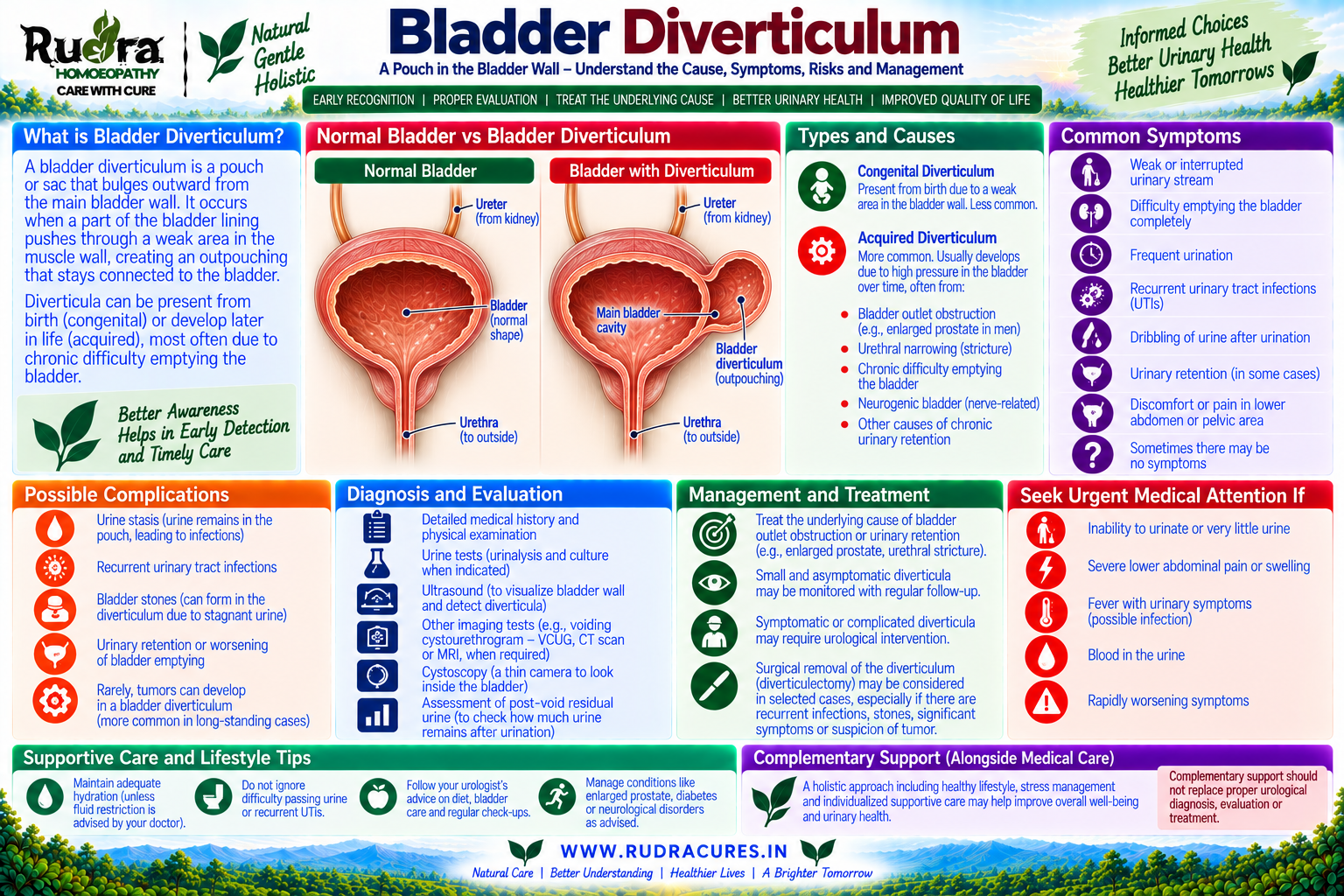
मलाशय/मूत्राशय की थैली का बढ़ना / ब्लैडर डायवर्टिकुलम (Bladder Diverticulum): प्रकार, कारण, लक्षण और सुरक्षित होम्योपैथिक दृष्टिकोण
The successful management of complex neuro-metabolic and urological disorders requires complete biological insight, appropriate lifestyle parameter monitoring, and a natural approach to lower urinary tract balance. Bladder Diverticulum (Diverticulosis Vesicae / Vesical Wall Outpouching) is a structural condition characterized by the formation of an abnormal pouch or sac in the bladder wall, caused by the mucosal lining herniating through weakened detrusor muscle fibers. Rather than being a simple localized error or an isolated consequence of aging, chronic or acute Bladder Diverticulum occurs when your body’s internal PNEI (Psycho-Neuro-Endocrine-Immunology) Matrix—the complex communication network connecting your mind, autonomic nervous system, and lower urinary tract—reaches a state of severe uncoupling. Homeopathy approaches constitutional support and urological rehabilitation by focusing on strengthening your vital force, supporting natural detrusor muscle tone, and safely re-tuning voiding mechanics organically alongside standard medical tracking from the root.
मूत्राशय (Urinary Bladder) की अंदरूनी दीवार का कमजोर होकर बाहर की तरफ एक छोटी या बड़ी थैली (Sac/Pouch) के रूप में निकल जाना (जिसे मेडिकल भाषा में **ब्लैडर डायवर्टिकुलम / Bladder Diverticulum** कहा जाता है) हमारे संपूर्ण उत्सर्जन तंत्र (Urinary System), प्रोस्टेट ग्रंथि और मूत्राशय की मांसपेशियों (Detrusor Muscle) से जुड़ी एक अत्यंत संवेदनशील और जटिल समस्या है। स्वस्थ अवस्था में हमारा मूत्राशय पेशाब को जमा करता है और पेशाब करते समय इसकी मांसपेशियां पूरी ताकत से सिकुड़कर मूत्राशय को पूरी तरह खाली कर देती हैं। लेकिन जब पुरुषों में प्रोस्टेट ग्रंथि के बढ़ने (BPH), मूत्रनली में रुकावट या सिकुड़न (Urethral Stricture), या नसों की कमजोरी (Neurogenic Bladder) के कारण पेशाब करने में बहुत जोर लगाना पड़ता है, तो मूत्राशय के अंदर भयंकर दबाव बनता है। इस अत्यधिक दबाव के कारण मूत्राशय की अंदरूनी कोमल परत कमजोर मांसपेशियों के बीच से बाहर की तरफ गुब्बारे की तरह उभर जाती है। इसके कारण **मरीज को पेशाब करने के तुरंत बाद दोबारा पेशाब की इच्छा होना (Double Voiding), थैली में बचे हुए पेशाब के कारण बार-बार इंफेक्शन (Recurrent UTI) होना, पेशाब में खून या मवाद आना, और मूत्राशय में पथरी (Bladder Stones) बनना** जैसी गंभीर समस्याएं पैदा हो जाती हैं। पारंपरिक इलाज में रुकावट को दूर करने या थैली को सर्जरी से काटने की सलाह दी जाती है, लेकिन जब तक मूत्राशय की मांसपेशियों को अंदरूनी ताकत नहीं मिलती, रुकावट दोबारा हो सकती है। होम्योपैथी बिना किसी ऑपरेशन के, प्रोस्टेट की सूजन को घटाने, मूत्रनली के संकुचन को खोलने और मूत्राशय की मांसपेशियों को प्राकृतिक ताकत देकर पेशाब की रुकावट को स्वाभाविक रूप से दूर करने में मदद करती है।
Primary Types and Clinical Classification of Bladder Diverticulum
Because vesical diverticula develop from distinct biological causes and structural mechanisms, they are clinically grouped into the following primary types:
- जन्मजात ब्लैडर डायवर्टिकुलम (Congenital Bladder Diverticulum): Present from birth, typically originating from a localized weakness in the detrusor muscle coat near the ureteral orifices (Hutch Diverticulum) or generalized connective tissue laxity, without any lower urinary tract obstruction.
- अधिग्रहित / रुकावट जनित डायवर्टिकुलम (Acquired Mechanical Diverticulum): The most common form in adults, caused by long-standing high-pressure voiding strain due to Bladder Outlet Obstruction (BPH, urethral stricture, or bladder neck sclerosis).
- न्यूरोजेनिक डायवर्टिकुलम (Neurogenic Bladder Diverticulum): Driven by central or peripheral nerve damage (spinal cord injury, multiple sclerosis, stroke) causing detrusor-sphincter dyssynergia and uncoordinated voiding dynamics.
- जटिल डायवर्टिकुलम (Complicated Diverticulosis): Long-standing pouches where urine stagnates continuously, leading to chronic urosepsis, diverticular stone formation, severe hematuria, or mucosal cell metaplasia.
Possible Root Causes of Bladder Diverticulum and Urinary Stasis
Common Warning Signs & Symptoms of Bladder Diverticulum
- **Double Voiding (Two-Stage Urination):** Passing urine normally, then feeling the urge to void a substantial amount again immediately within 2-5 minutes as urine stored inside the diverticular sac drains back into the main bladder cavity.
- **Recurrent Urinary Tract Infections (UTIs):** Persistent, repeating bacterial bladder infections driven by stagnant urine pooling in the non-contractile diverticular pouch.
- **Urinary Hesitation & Weak Flow:** Difficulty starting the urine stream, narrow or split stream, and prolonged dribbling at the end of voiding.
- **Constant Pelvic Fullness & Pressure:** Uncomfortable aching weight or sensation of incomplete emptying in the lower abdomen even right after urinating.
- **Hematuria & Cloudy Mucous Urine:** Passing dark, rusty, or blood-stained urine containing thick, foul-smelling mucous threads or chalky sand.
मुख्य चेतावनी लक्षण: पेशाब करने के तुरंत 2 मिनट बाद दोबारा तेज पेशाब आना (Double Voiding), पेशाब की धार बहुत पतली या रुक-रुक कर आना, बार-बार पेशाब में भयंकर जलन व इंफेक्शन होना, पेट के निचले हिस्से में हमेशा भारीपन महसूस होना, और पेशाब में खून या बदबूदार मवाद के अंश आना।
Homeopathic Approach to Detrusor Tone and Lower Urinary Health
Homeopathy approaches auxiliary bladder diverticulum management and recovery by focusing on De-compressing Voiding Pressure and Restoring Muscle Tone. Conventional primary options rely heavily on long-term catheterization, chemical prostate reducers, or invasive surgical resection (Diverticulectomy) to cut away the pouch. While surgical intervention is an absolute necessity in severe cases with complete urinary blockage or malignant transformations, long-term chemical reliance does not correct underlying detrusor muscle weakness or clear fibrotic urethral strictures, causing voiding strain to return over time. Homeopathic medicine works beautifully from within as a gentle, completely non-toxic oral adjunctive and complementary support. It treats your individual urinary and physical symptoms as vital biological guides, selecting a unique natural remedy that matches your physical build and precise urological triggers to gently support your detrusor and prostate pathways naturally, helping soothe prostate inflammation, soften fibrotic strictures, improve bladder wall elasticity, clear chronic urine stasis, and safely restore normal urination naturally without secondary side effects or drug conflicts.
मुख्य होम्योपैथिक दवाएं और उनके लक्षण (Homeopathic Medicines & Symptoms Basis)
होम्योपैथी में प्रत्येक रोगी के विशिष्ट मानसिक व शारीरिक लक्षणों के आधार पर दवा का चुनाव किया जाता है। यहाँ ब्लैडर डायवर्टिकुलम, प्रोस्टेट वृद्धि, और पेशाब की रुकावट के सहायक उपचार के लिए उपयोग होने वाली प्रमुख प्राकृतिक औषधियों की बुनियादी जानकारी दी जा रही है:
लक्षण और पहचान: यह पेशाब की भयंकर रुकावट और डायवर्टिकुलम के कारण होने वाले दर्द की सबसे प्रमुख दवा है। इसका सबसे पक्का लक्षण यह है कि **मरीज को पेशाब करने के लिए हाथों और घुटनों के बल बैठना पड़ता है (Kneeling posture) और सिर टेककर बहुत जोर लगाना पड़ता है**, तब जाकर पेशाब की कुछ बूंदें टपकती हैं। दर्द मूत्राशय से शुरू होकर जांघों और पैरों की उंगलियों तक जाता है।
लक्षण और पहचान: प्रोस्टेट ग्रंथि के बढ़ने (BPH) के कारण होने वाले डायवर्टिकुलम की सबसे बेहतरीन ऑर्गनोपैथिक दवा। मरीज को **रात के समय बार-बार पेशाब की तीव्र इच्छा होती है, पेशाब की धार बहुत कमजोर होती है और बूंद-बूंद करके टपकता है**। मूत्राशय के मुहाने पर भारीपन और कड़ापन महसूस होता है। यह प्रोस्टेट की सूजन को प्राकृतिक रूप से कम करती है।
लक्षण और पहचान: यह दवा उन मरीजों के लिए अचूक है जिन्हें **केवल खड़े होकर और पैरों को फैलाकर आगे झुकने पर ही पेशाब आ पाता है**। मरीज को ऐसा महसूस होता है जैसे उसके अंडकोष और गुदा के बीच (Perineum) कोई भारी गेंद रखी हुई है। पेशाब में गाढ़ा, रस्सी जैसा, बदबूदार मवाद और म्यूकस आता है।
लक्षण और पहचान: सुजाक (Gonorrhea) के पुराने इंफेक्शन या घाव के कारण **मूत्रनली में संकुचन या सिकुड़न (Urethral Stricture) होने से बनने वाले डायवर्टिकुलम की मुख्य दवा**। पेशाब की धार बहुत पतली, दो हिस्सों में बंटी हुई (Split stream) या रुक-रुक कर आती है। पेशाब शुरू करते समय मूत्रनली में तेज जलन होती है।
लक्षण और पहचान: जब डायवर्टिकुलम की थैली के अंदर पेशाब रुकने से पथरी (Bladder Stone) या कंकड़ी बन जाती है। इसका सबसे अनोखा लक्षण है — **पेशाब खत्म होते ही अंत में भयंकर, असहनीय दर्द और जलन (Terminal dysuria) होना**। मरीज केवल खड़े होकर ही पेशाब कर पाता है और पेशाब में सफेद रेत या कंकड़ी आती है।
लक्षण और पहचान: मूत्राशय की मांसपेशियों के लकवे या अत्यधिक कमजोरी (Detrusor Muscle Paralysis) की दवा। मरीज को **पेशाब जमा होने का एहसास ही नहीं होता या खांसने, छींकने व चलने पर पेशाब अपने आप निकल जाता है**। डायवर्टिकुलम की थैली में जमा आखिरी बूंदें बाहर निकालने की ताकत मूत्राशय में नहीं बचती।
लक्षण और पहचान: जब डायवर्टिकुलम की थैली में रुका हुआ पेशाब भयंकर इंफेक्शन और मवाद (Severe Stasis Cystitis) पैदा कर देता है। **पेशाब करने से पहले, पेशाब के दौरान और पेशाब करने के बाद लगातार आग जैसी भयंकर जलन और तड़पाने वाला दर्द (Tenesmus) होता है**। पेशाब की हर एक बूंद के साथ मरीज दर्द से चीख उठता है और पेशाब में खून आता है।
Frequently Asked Questions (FAQs) – ब्लैडर डायवर्टिकुलम और मूत्राशय की समस्याओं से जुड़े जरूरी सवाल
1. What is a Bladder Diverticulum and how does it form?
A Bladder Diverticulum is an abnormal pouch or pouch-like herniation that forms in the bladder wall. It occurs when high intravesical pressure (caused by prostate enlargement or urethral stricture) forces the soft inner lining of the bladder to push out through weak gaps in the surrounding muscle layer.
ब्लैडर डायवर्टिकुलम मूत्राशय की दीवार में बनने वाली एक असामान्य थैली या गड्ढा है। जब प्रोस्टेट बढ़ने या मूत्रनली में सिकुड़न के कारण पेशाब करने में बहुत जोर लगाना पड़ता है, तो मूत्राशय की अंदरूनी कोमल परत कमजोर मांसपेशियों को चीरकर बाहर गुब्बारे की तरह निकल आती है।
2. What is ”Double Voiding” and why is it a key symptom of Bladder Diverticulum?
Double Voiding is the act of urinating, feeling relieved, and then immediately needing to urinate again within 2-5 minutes. This happens because during urination, urine is forced into the diverticular pouch. Once micturition stops, the trapped urine drains back into the main bladder cavity, instantly triggering a fresh voiding urge.
डबल वॉइडिंग का मतलब है पेशाब करने के तुरंत 2 से 5 मिनट बाद दोबारा तेज पेशाब आना। ऐसा इसलिए होता है क्योंकि पेशाब करते समय कुछ पेशाब डायवर्टिकुलम की थैली में भर जाता है। पेशाब खत्म होते ही वह रुका हुआ पेशाब वापस मूत्राशय में आ जाता है, जिससे तुरंत दोबारा पेशाब की इच्छा होने लगती है।
3. Why do people with Bladder Diverticulum get frequent, repeating Urinary Tract Infections (UTIs)?
The diverticular pouch lacks smooth muscle tissue (detrusor), meaning it cannot contract or squeeze itself empty during urination. Stagnant urine pools inside the pouch indefinitely, acting as a breeding ground for bacteria and causing chronic, recurrent UTIs that resist standard antibiotics.
डायवर्टिकुलम की थैली में मांसपेशियां नहीं होतीं, इसलिए यह पेशाब करते समय सिकुड़कर खुद को खाली नहीं कर पाती। थैली में लगातार रुका हुआ बासी पेशाब बैक्टीरिया के पनपने का केंद्र बन जाता है, जिससे बार-बार भयंकर इंफेक्शन होता रहता है।
4. Can bladder stones form inside a Bladder Diverticulum?
Yes, absolutely. Continuous urinary stagnation allows dissolved mineral crystals (uric acid, calcium oxalate) to precipitate and crystallize inside the non-draining pouch. Over time, these crystals coalesce into large, hard vesical calculi that cause severe pain and hematuria.
हाँ, बिल्कुल। थैली में महीनों तक पेशाब रुके रहने से पेशाब में मौजूद यूरिक एसिड और कैल्शियम के कण नीचे बैठने लगते हैं और धीरे-धीरे जमकर बड़ी पथरी (Bladder Stone) का रूप ले लेते हैं, जिससे तेज दर्द और खून आने लगता है।
5. What is the difference between a True (Congenital) and False (Acquired) Bladder Diverticulum?
A True (Congenital) Diverticulum contains all muscle layers of the bladder wall and is usually present at birth as a single pouch near ureters. A False (Acquired) Diverticulum contains only mucosal and submucosal layers herniated through muscular gaps, usually present as multiple pouches caused by high pressure from BPH or strictures.
सच्चा (जन्मजात) डायवर्टिकुलम जन्म से होता है और इसमें मूत्राशय की सभी मांसपेशियां शामिल होती हैं। जबकि झूठा (अधिग्रहित) डायवर्टिकुलम उम्र बढ़ने के साथ प्रोस्टेट या रुकावट के दबाव से बनता है, जिसमें केवल अंदरूनी झिल्ली मांसपेशियों के बीच से बाहर निकल आती है।
6. Why does Pareira Brava require the patient to get on hands and knees to urinate?
Pareira Brava matches severe mechanical bladder neck obstruction and urethral spasms. Assuming a posture on hands and knees utilizes gravity to shift the heavy prostate or diverticular sac away from the bladder neck opening, temporarily unblocking urine flow.
यह दवा पेशाब के मुहाने पर भयंकर रुकावट को दर्शाती है। हाथों और घुटनों के बल बैठने से गुरुत्वाकर्षण के कारण बढ़ा हुआ प्रोस्टेट या थैली का दबाव पेशाब की नली से हट जाता है, जिससे पेशाब की कुछ बूंदें बाहर निकल पाती हैं।
7. How does an enlarged prostate (BPH) directly lead to Bladder Diverticulum in men?
As the prostate gland enlarges, it compresses the prostatic urethra, blocking the exit. The detrusor muscle must contract with tremendous force to push urine past the blockage. This high intravesical pressure causes bladder muscle fibers to split (trabeculation), forcing the inner mucosal layer to herniate outward.
जब पुरुषों में प्रोस्टेट ग्रंथि बढ़ती है, तो वह पेशाब की नली को भींच देती है। मूत्राशय को पेशाब बाहर फेंकने के लिए बहुत ज्यादा जोर लगाना पड़ता है। इस भयंकर दबाव से मूत्राशय की दीवारें फटने लगती हैं और कमजोर जगहों से थैली बाहर निकल आती है।
8. Can a Bladder Diverticulum cause kidney damage or Pyelonephritis?
Yes. If a diverticulum develops near the ureteral orifice (Hutch diverticulum) or creates high back-pressure inside the bladder, it can block normal urine flow from the kidneys or cause vesicoureteral reflux (VUR). This forces infected urine backward into the kidneys, risking chronic renal failure.
हाँ! अगर डायवर्टिकुलम गुर्दे से आने वाली नली (Ureter) के पास बन जाए, तो यह पेशाब को वापस गुर्दों की तरफ फेंकने लगता है (Reflux)। इससे गुर्दों में इंफेक्शन (Pyelonephritis) फैल सकता है और गुर्दे खराब होने का खतरा रहता है।
9. How do doctors diagnose a Bladder Diverticulum accurately?
Diagnosis is confirmed using Ultrasonography (USG KUB) with Post-Void Residual (PVR) measurement, Voiding Cystourethrogram (VCUG) fluoroscopy images documenting the sac during urination, and diagnostic Cystoscopy to directly visualize the diverticular neck inside the bladder.
इसकी सटीक पहचान अल्ट्रासाउंड (USG KUB with PVR), स्पेशल पेशाब एक्सरे (VCUG), और सिस्टोस्कोपी (कैमरे द्वारा मूत्राशय की अंदरूनी जांच) करके की जाती है, जिससे थैली का आकार और स्थान साफ दिख जाता है।
10. Can individualized homeopathy help safely reduce prostate swelling and avoid surgery?
Yes, absolutely. Individualized homeopathic remedies like Sabal Serrulata, Conium Mac, and Chimaphila work targetedly to reduce glandular prostatic edema, soften fibrotic tissue induration, and lower bladder neck resistance, allowing urine to flow freely and halting further diverticular expansion naturally.
हाँ, बिल्कुल। सबाल सेरुलाटा, कोनियम और चिमाफिला जैसी लक्षित होम्योपैथिक दवाएं प्रोस्टेट की सूजन और कड़ेपन को प्राकृतिक रूप से पिघलाकर कम करती हैं, जिससे पेशाब का रास्ता खुल जाता है और ऑपरेशन की नौबत से बचा जा सकता है।
11. Why does Sarsaparilla have severe pain specifically at the END of urination?
As the bladder finishes emptying, the collapsing detrusor muscle walls press directly against raw, inflamed diverticular necks or sharp sand/gravel resting at the trigone base, firing acute, excruciating terminal nerve spasms.
पेशाब खत्म होते ही जब मूत्राशय पूरी तरह सिकुड़ता है, तो उसकी सूजी हुई दीवारें और नीचे बैठी कंकड़ी आपस में बुरी तरह भींच जाती हैं, जिससे पेशाब के बिल्कुल अंत में तड़पाने वाला दर्द होता है।
12. Is a Bladder Diverticulum dangerous or can it become cancerous?
While most diverticula are benign structural changes, long-standing chronic urine stasis and mucosal irritation inside a non-draining sac carry a small risk (2-5%) of developing dysplastic mucosal changes or Squamous Cell Carcinoma. Regular monitoring via cystoscopy is recommended.
हालांकि यह कोई कैंसर नहीं है, लेकिन थैली के अंदर महीनों तक रुके हुए सड़े पेशाब के लगातार संपर्क में रहने से वहां की झिल्ली में खराबी आने और कैंसर (Carcinoma) बनने का 2 से 5% खतरा रहता है। इसलिए इसकी नियमित जांच जरूरी है।
13. Can urethral strictures (narrow urine pipe) cause a Bladder Diverticulum?
Yes. A urethral stricture acts as a narrow dam in the urine pipe. Every time the bladder attempts to void, it hits this high-resistance wall, driving massive back-pressure into the bladder cavity that forces muscle fibers apart and creates diverticular sacs.
हाँ! मूत्रनली की सिकुड़न पेशाब के पाइप में बांध की तरह काम करती है। जब भी मूत्राशय पेशाब बाहर फेंकने की कोशिश करता है, तो इस रुकावट से टकराकर सारा दबाव वापस मूत्राशय पर पड़ता है, जिससे दीवारें फटकर थैलियां बन जाती हैं।
14. How long does homeopathic supportive treatment take to show measurable improvement in urine flow?
Noticeable relief from acute burning, urinary hesitation, and painful straining often begins within 2 to 4 weeks under targeted organopathic remedies. However, permanently reducing post-void residual urine volume, softening prostate induration, and stabilizing detrusor tone requires continuous constitutional care over 3 to 6 months.
पेशाब की जलन, रुकावट और जोर लगाने के कष्ट में पहले 2 से 4 हफ़्तों के भीतर ही बहुत अच्छा आराम महसूस होने लगता है। लेकिन प्रोस्टेट का आकार कम करने, मूत्रनली का रास्ता साफ करने और मूत्राशय को मजबूत बनाने के लिए 3 से 6 महीने का नियमित इलाज आवश्यक है।
15. How can I consult an expert doctor for personalized urological management?
You can connect directly with our clinical expert team via WhatsApp to share your USG KUB reports, PVR scans, urine test logs, and symptoms for fully confidential, expert guidance.
आप अपनी अल्ट्रासाउंड रिपोर्ट (USG KUB), PVR स्कैन और लक्षणों के विवरण के साथ हमारे विशेषज्ञ डॉक्टर से व्हाट्सएप पर सीधे और गोपनीय परामर्श ले सकते हैं।
Lifestyle and Diet Guidelines for Supporting Urinary Health Successfully
- **Practice Scheduled Double Voiding Routine:** Never rush micturition. After finishing your initial stream, sit comfortably, wait 2 to 3 minutes, lean slightly forward, and attempt to void a second time to drain urine stored inside the diverticular sac cleanly.
- **Maintain Optimal Hydration Without Fluid Overloading:** Drink 2 to 2.5 liters of clean water evenly distributed throughout daytime hours. Avoid drinking large volumes of fluid all at once or right before bedtime to prevent sudden acute bladder over-distension.
- **Strictly Eliminate Bladder Mucosal Irritants:** Completely avoid coffee, strong black tea, caffeinated sodas, alcohol, hot red chili spices, artificial sweeteners, and smoking. These substances irritate the vesical lining, triggering violent urethral spasms and voiding distress.
- **Apply Gentle Lower Abdominal Fomentation & Warm Baths:** Use a warm water bottle or take warm sitz baths for 15 minutes daily. Moist heat relaxes spastic urethral sphincters and lowers bladder neck voiding resistance naturally.
- **Never Ignore or Suppress the Natural Urge to Void:** Urinate immediately when the urge arises. Suppressing urination forces high pressure back into the diverticular sac, expanding the weak muscular gaps further.
Understanding Diagnostic Milestones: A Balanced Approach
Monitoring your urological structural parameters and renal efficiency under proper clinical tracking is an intelligent step toward lifelong bladder protection and complete peace of mind.
| Assessment Type | Why It Is Crucial for Success | Clinical Focus Area |
|---|---|---|
| Ultrasonography (USG KUB) with Post-Void Residual (PVR) Volume | Accurately measures bladder wall thickness, identifies diverticular sac dimensions, and calculates exact urine volume remaining after voiding. | Tracks the active physical reduction of stagnant post-void residual urine volume and confirms improved detrusor emptying over time. |
| Voiding Cystourethrogram (VCUG) Fluoroscopy | Provides dynamic real-time X-ray contrast imaging of the bladder filling and emptying phases, mapping diverticular neck width and vesicoureteral reflux. | Document precise structural stabilization of the diverticular neck and rules out dangerous urine back-flow to kidneys. |
| Renal Function Panel (Serum Creatinine & Blood Urea) & Urine Culture | Evaluates upper urinary tract health to ensure back-pressure is not impairing kidney filtration, while monitoring for bacterial stasis cystitis. | Verifies complete preservation of renal function and confirms clean, sterile, bacterial-free urinary transit. |
Bladder Diverticulum and obstructive lower urinary tract disorders represent a complex structural and constitutional recovery phase that responds beautifully when supported with proper double-voiding discipline, non-irritating diet, pelvic warmth, and expert professional tracking. Your body’s lower urinary networks possess a wonderful, natural capacity to protect, stabilize, and strengthen themselves completely when guided correctly alongside standard urological screening lines. Diagnostic perimetries should be used simply as helpful milestones to confirm your clean, steady progress.
Why Choose Rudra Homoeopathy?
- 100% natural, chemical-free supportive protocols tailored with deep respect around your unique physical build, lifestyle, and urological needs.
- Proven clinical experience in safely providing non-invasive adjunctive supportive care for severe urinary straining, BPH enlargement, urethral stricture obstruction, double voiding, and chronic stasis cystitis safely.
- Focuses on comprehensive anti-miasmatic tissue purification to support your detrusor muscle, prostate, and renal systems from progressive structural degenerations.
- Compassionate, expert care that respects your journey, ensuring complete patient privacy, total confidentiality, and vibrant internal health.
Conclusion
Homeopathy offers an exceptionally safe, gentle, and deeply restorative path for individuals looking to support their lower urinary tract health, clear voiding obstructions, and reclaim their internal vitality. By targeting the true underlying root causes of bladder outlet pressure, detrusor weakness, and PNEI communication blocks, master remedies work in perfect adjunctive alignment with your vital force to clear deep vesical stasis, protect vital renal-urological networks, and restore perfect internal peace, confidence, and wellness beautifully.
Tone Your Bladder Networks, Support Your Urinary Vitality Naturally
Stop letting debilitating urinary hesitation, painful double voiding, and distressing prostatic pressure exhaust your life force. Re-tune your PNEI matrix and support your cellular urological health from the root with personalized, fully confidential, expert homeopathic care.
💬 Consult with Expert on WhatsApp with Complete Privacy🔒 Unlock the Advanced Master Repository Content
Take your clinical study far beyond the basics. Unlock this post’s advanced repository to access deep-seated miasmatic corrections, separate precise type-by-type data tables with potencies, and specialized practitioner protocols, including:
Advanced Clinical Comparison Tool
Compare symptoms, cross-reference Materia Medica notes, and analyze repertorial rubrics side-by-side for precise case evaluation.
Access Clinical Tool →